
Fleet Vehicle Modification Certification: The Complete Engineering Compliance Guide

Updated: Sep 9
What if the very upgrades designed to make your fleet more productive are actually the biggest threat to your balance sheet? For many Australian operators, a non-compliant modification is a ticking time bomb of massive fines and insurance coverage issues policies. Securing a professional fleet vehicle modification certification isn't just about satisfying a regulator; it's a strategic engineering decision that protects your drivers and your bottom line.
It's understandable to feel frustrated by the friction between state-based light vehicle rules and the National Heavy Vehicle Regulator standards. You want your vehicles on the road, not sitting idle while you're untangling the complexities of VSB 14 or the VSB6 V3.2 requirements that have governed heavy vehicles since 2023. This guide will help you master the complexities of fleet compliance with our expert look at vehicle modification certification and Australian engineering standards. We'll provide a clear path through the certification process, from initial compliance inspections to the final sign-off by an Approved Vehicle Examiner; ensuring your fleet remains both legal and highly functional.
Table of Contents
What is Fleet Vehicle Modification Certification?
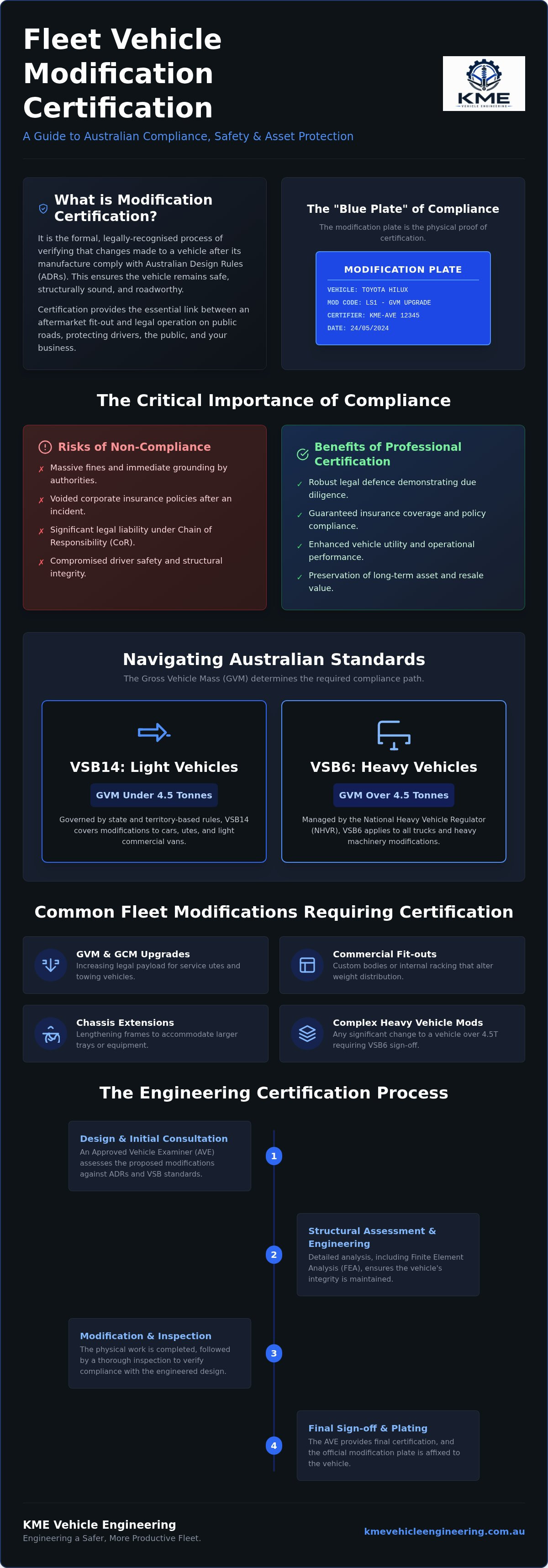
In the Australian commercial landscape, vehicle modification certification is the formal process of verifying that any changes made to a vehicle after its original manufacture comply with the relevant Australian Design Rules (ADRs). While many vehicles enter service under a standard Motor vehicle type approval, fleet-specific requirements often necessitate alterations that move the vehicle outside these original specifications. This certification ensures that these changes don't compromise safety, structural integrity, or roadworthiness.
The "blue plate" or modification plate is the physical evidence of this process. It is a permanent record fixed to the vehicle, signifying that a qualified engineer has assessed the modification against national standards. It's more than just a tag; it's a legal declaration. Without this verification, a modified vehicle is technically unroadworthy. This can lead to immediate grounding by transport authorities or the rejection of insurance claims following a workplace incident. For any business, fleet vehicle modification certification is the essential link between an aftermarket fit-out and legal operation on public roads.
Distinguishing between minor modifications and significant structural changes is critical for fleet managers. Minor additions, like fitting a standard roof rack, generally don't require formal sign-off. However, once you begin altering the chassis, suspension geometry, or load-carrying capacity, you've entered the realm of regulated engineering. Certification acts as the bridge that validates these complex upgrades, ensuring the vehicle remains safe for the driver and other road users.
The Legal Framework for Fleet Compliance
Fleet managers operate under a strict Chain of Responsibility (CoR). This means you're legally accountable for the safety of your vehicles, regardless of who performed the modifications. Obtaining a fleet vehicle modification certification through an Approved Vehicle Certifier (AVC) provides a robust legal defence. It demonstrates that you've exercised due diligence by having a "steady hand" oversee the engineering. This professional sign-off protects against personal and corporate liability if a mechanical failure occurs.
Common Fleet Modifications Requiring Certification
Most commercial fleets require specific upgrades to meet their operational needs. These modifications often fall under the national VSB6 or state-based VSB14 standards. Common examples include:
GVM and GCM upgrades: Essential for service utes and towing vehicles to carry heavier payloads legally.
Commercial Fit-outs: Custom bodies or specialised internal racking that alters the vehicle's original weight distribution or structural profile.
Chassis Extensions: Lengthening a frame to accommodate larger trays or specialised load-carrying equipment.
Heavy Vehicle Certification: Complex modifications to trucks over 4.5 tonnes that must meet VSB6 V3.2 requirements.
Understanding Australian Standards: VSB14 vs VSB6
The National Code of Practice (NCOP) serves as the technical blueprint for vehicle modifications across Australia. It's designed to ensure that any alteration to a vehicle’s original design remains strictly compliant with the Australian Design Rules (ADRs). These ADRs establish the national standards for vehicle safety, anti-theft, and emissions. When you pursue a fleet vehicle modification certification, your engineering partner must determine which specific standard applies to each asset based on its Gross Vehicle Mass (GVM).
The primary distinction lies at the 4,500kg GVM threshold. For fleet operators managing a mix of service utes and heavy trucks, understanding this divide is essential. Light vehicles follow a different engineering path than heavy vehicles. ADRs dictate the boundaries of what is permissible, covering critical areas such as:
Braking efficiency and electronic stability control.
Occupant protection and seatbelt anchorage points.
Vehicle lighting and signalling requirements.
Structural integrity under increased load conditions.
Applying the wrong standard doesn't just lead to compliance failures; it can result in structural designs that are either insufficient for heavy loads or unnecessarily restrictive for light commercial use. Adopting a nationally recognised engineering approach ensures your fleet remains compliant as it moves across state borders. If you're unsure which standard applies to your specific vehicle upgrades, a professional vehicle compliance inspection can clarify the necessary certification path.
VSB14: Light Vehicle Modification Standards
VSB14 applies to vehicles with a GVM of 4,500kg or less. This category includes the majority of service vans, 4WDs, and light utes used in field operations. The standard is divided into specific sections that govern modifications to suspension, braking systems, and bodywork. For example, ensuring what is a GVM upgrade is performed correctly requires strict adherence to VSB14 Section LS. This ensures that the increased load-carrying capacity doesn't compromise the vehicle's braking performance or stability.
VSB6: Heavy Vehicle Modification Standards
For assets over 4,500kg GVM, VSB6 is the definitive national standard. This code is significantly more technical, focusing heavily on chassis integrity and axle configurations. Because heavy vehicles often undergo more invasive changes, such as chassis extensions or the addition of specialised load-carrying equipment, the engineering requirements are more rigorous. Understanding how VSB6 governs heavy vehicle commercial fit-outs is vital for maintaining a safe and legal heavy fleet.
The Engineering Process: From Design to Sign-off
The path to a compliant fleet begins long before a technician picks up a spanner. Engaging an engineer at the conceptual stage is the most effective way to prevent costly rework and ensure that your fleet vehicle modification certification is achievable from the start. This proactive approach allows for the identification of structural limitations before they become operational failures. Modern engineering relies on 3D modelling and rigorous structural assessment to simulate how a modification will perform under real-world conditions. This digital verification ensures that the proposed upgrades won't compromise the vehicle's original safety systems or structural integrity.
For fleet managers, the primary concern is often the impact on operational availability. Managing the engineering timeline for a fleet-wide rollout requires a methodical approach to minimise downtime. By batching inspections and synchronising the certification process with scheduled maintenance or fit-out windows, you can ensure that vehicles aren't sitting idle waiting for a sign-off. The final phase of the process is a physical inspection and testing regime. This serves as the ultimate validation of the build's quality and compliance, moving the vehicle from a workshop project to a certified commercial asset.
Initial Assessment and Design
The first step involves evaluating the vehicle's base capacity against the specific requirements of the fit-out. If a vehicle has suffered previous damage or requires significant frame alterations, developing a chassis repair assessment or a detailed structural plan is necessary. Consulting with a specialist engineer early ensures the design is certifiable and aligns with national standards. This prevents the common pitfall of completing a build only to find it cannot be legally certified because it exceeds axle ratings or compromises the chassis rail's structural integrity.
Testing, Verification, and Documentation
Once the physical modifications are complete, the vehicle must undergo a series of performance tests. For GVM upgrades, this typically involves brake testing and high-speed lane change manoeuvres to verify that the vehicle remains stable and controllable under its new maximum weight. Following successful testing, the engineer compiles a comprehensive Vehicle Modification Report (VMR). This document is submitted to the relevant state or national regulatory body for approval. The process concludes with the installation of a permanent modification plate and the formal updating of the vehicle's registry details, providing you with total greater confidence that your asset is 100% legal.
Commercial Benefits: Why Certification is a Business Asset
Viewing fleet vehicle modification certification as a mere bureaucratic hurdle is a mistake that can cost a business dearly. For sophisticated operators, engineering compliance is a strategic asset that protects the company's balance sheet. A vehicle with a fully documented certification history and a valid modification plate is far more liquid on the secondary market. Buyers are willing to pay a premium for the assurance that the upgrades were performed to national standards, whereas uncertified vehicles often face steep depreciation or restricted buyer pools. This documentation serves as a "birth certificate" for the modification, proving that the structural integrity remains intact.
Operational capability is another area where certification provides a clear competitive edge. By engineering vehicles to handle specific, high-demand tasks safely, you can often do more with fewer assets. Instead of running multiple light vehicles that are constantly hovering at their weight limits, a single, correctly modified and certified heavy vehicle might do the job more efficiently. This isn't just about moving more weight; it's about providing your team with tools that are legally fit for purpose. Staff retention is closely linked to this. Providing employees with safe, compliant work vehicles demonstrates a commitment to their welfare that goes beyond basic corporate platitudes, ensuring they don't feel "at risk" while performing their duties.
Risk Mitigation and Insurance Integrity
The most immediate commercial risk of uncertified modifications is the potential for insurance coverage issues. Insurers base their premiums and coverage on the vehicle's "as-manufactured" state or its "certified-modified" state. If a structural failure or accident occurs and an uncertified modification is discovered, the insurer can rightfully refuse the claim. This leaves the business exposed to massive financial losses. Beyond the direct costs, Work Health and Safety (WHS) laws require employers to provide a safe workplace, which extends to the vehicles drivers operate. Proactive GVM upgrades help you avoid the common overloading trap, ensuring your fleet remains within legal weight limits even when fully loaded with specialised tools and equipment.
Maximising Fleet Versatility
Standardising modification packages across your fleet makes maintenance and part replacement significantly easier. By utilising specialised commercial vehicle fit-out Darwin techniques, you can create multi-purpose assets that adapt to various operational needs without compromising on safety. The long-term ROI of professional engineering sign-off is undeniable. It reduces legal exposure, lowers long-term maintenance costs through better design, and ensures your fleet remains a productive force rather than a liability. If you are looking to secure your assets and protect your drivers, our team can provide the necessary vehicle modification certification to keep your business moving forward.
Choosing the Right Engineering Partner for Your Fleet
Selecting an engineering partner is a high-stakes decision for any fleet manager. You aren't just looking for a signatory; you're looking for a technical specialist who understands the operational realities of a commercial fleet. The right partner provides more than just a fleet vehicle modification certification; they offer a collaborative partnership that ensures your assets are safe, compliant, and productive. National recognition is non-negotiable. If your vehicles operate across state lines, your engineer must have a deep understanding of how state-based light vehicle rules interact with national heavy vehicle standards.
Technical breadth is equally critical. A partner who only understands light 4WDs won't be able to provide the heavy vehicle certification required for your larger trucks. Beyond the technical codes, look for a "Bold Innovator." Many fleet requirements involve unconventional or "weird" engineering puzzles that standard off-the-shelf solutions can't solve. You need a steady hand who respects the safety standards but possesses the creativity to make complex modifications possible through precise engineering design and structural assessment.
The KME Difference: Technical Mastery Meets Service
KME Vehicle Engineering provides a methodical, steady approach to complex GVM, GCM, and ATM upgrades. We specialise in delivering engineering solutions that others might find too challenging, including the design and certification of the 300 Series LandCruiser suspension kit. Our team stays current with the current 2026 GVM upgrade regulations to ensure your high-value assets remain fully compliant. Whether you require a simple sign-off for a service body or a complex structural repair plan for a damaged chassis, we provide the technical mastery needed to keep your fleet on the road.
Streamlining Your Fleet Certification
We understand that operational downtime is the enemy of fleet efficiency. To minimise this, we coordinate closely with your fit-out providers, ensuring that compliance is "baked in" to the build process rather than added as an afterthought. Our fleet vehicle modification certification process includes transparent reporting and clear paths to legal sign-off, removing the confusion often associated with state and federal modification rules. We take the time to be thorough, ensuring every aspect of your service is accounted for before the final modification plate is issued. Contact us today to discuss your fleet’s specific engineering requirements and secure the greater confidence that comes with professional certification.
Future-Proofing Your Fleet Through Engineering Excellence
Operating a modern commercial fleet requires a disciplined approach to safety and regulatory standards. Securing a professional fleet vehicle modification certification is about more than just legal box-ticking; it's a fundamental strategy to mitigate corporate risk and preserve asset value. By mastering the technical distinction between VSB14 and VSB6 standards and involving engineers at the design stage, you ensure your vehicles remain productive tools rather than liabilities.
Whether you're managing light service utes or complex heavy trucks, the path to compliance is paved with technical precision and structural verification. KME Vehicle Engineering stands ready to guide you through these engineering puzzles. We are specialists in GVM, GCM, and ATM upgrades, providing comprehensive VSB6 heavy vehicle certification that meets national compliance standards for commercial fleets. Our steady hand ensures your modifications are safe, legal, and built to last. Secure your fleet's compliance with KME Vehicle Engineering today. We look forward to helping you build a safer, more efficient fleet.
Frequently Asked Questions
What happens if I modify a fleet vehicle without an engineering certificate?
Modifying a commercial vehicle without certification makes the asset technically unroadworthy and can lead to immediate grounding by transport authorities. It also provides insurers with a legal basis to void your comprehensive cover, leaving your business fully liable for any financial losses or personal injury claims resulting from a workplace incident.
Is a GVM upgrade certificate valid in every Australian state?
A GVM upgrade certificate's validity depends on whether the modification was performed under Federal or State regulations. Federal Second Stage Manufacture (SSM) approvals are recognised nationally before first registration; however, post-registration upgrades are subject to state-specific recognition rules that vary between jurisdictions like Queensland and New South Wales.
How long does the vehicle modification certification process typically take?
The timeline for fleet vehicle modification certification depends on the complexity of the engineering required and the testing involved. A standard compliance inspection for a simple body change might be completed within a few business days, while complex structural builds requiring brake testing and lane-change manoeuvres can take several weeks to finalise.
Does every minor fit-out, like a ladder rack, require an engineering sign-off?
Minor accessories such as ladder racks or standard internal shelving generally don't require formal engineering sign-off if they are fitted to manufacturer specifications. Certification is only necessary when the modification alters the vehicle's structural integrity, affects its original safety systems, or moves the asset outside its factory-specified dimensions or weight limits.
What is the difference between a second-stage manufacture and a post-registration modification?
Second-stage manufacture (SSM) occurs before a vehicle is first registered and is governed by federal Australian Design Rules. Post-registration modifications are performed on vehicles already in service and are regulated by state-based transport departments, often requiring a different certification path through an Approved Vehicle Examiner.
Can an engineer certify a vehicle that has already been modified by a third party?
An engineer can certify third-party modifications after conducting a thorough fleet vehicle modification certification inspection. They must verify that the existing work meets all relevant safety standards and ADRs, which may involve some disassembly or non-destructive testing to confirm the quality of the underlying structural changes.
What documents do I need to provide to the engineer for fleet certification?
You must provide the vehicle's VIN, current registration details, and technical specifications for any aftermarket components fitted. Engineers also require weighbridge certificates and documentation for specific parts, such as suspension kits or GVM upgrade components, to verify that the build aligns with the proposed engineering plan.
How often do I need to renew a vehicle modification certificate?
Vehicle modification certificates don't have an expiry date and remain valid for the life of the asset. You only need to seek new certification if the vehicle undergoes further structural changes or if a new modification is added that alters the configuration recorded on the original modification plate.


Comments